Live Pin
18 October, 2026
Live Pin is a concept prototype for WhatsApp live location. It keeps a friend's active location one glance away, even after the chat has moved on. The prototype uses fictional people, chat content, and location data; it is not affiliated with WhatsApp or Meta.
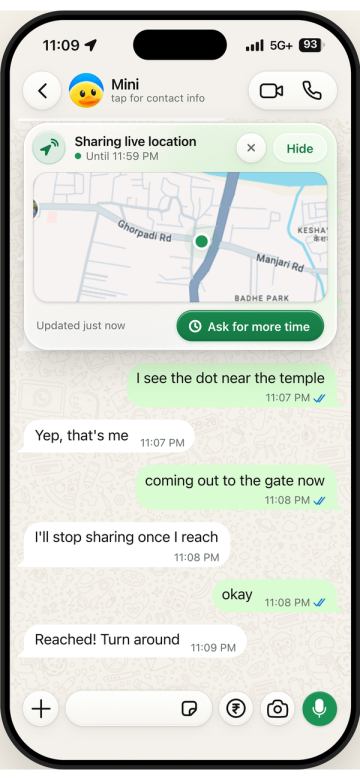
The core idea is simple: a live location is about right now, but it currently lives inside one message. As new messages arrive, that card scrolls away and the useful information gets harder to reach.
Making Live Location Stay Present
In the demo conversation, the original location card is 27 messages, roughly 1.3 screens above the latest message. In a real chat, that distance keeps growing. Checking a live location means scrolling through history, finding the card, and then opening it.
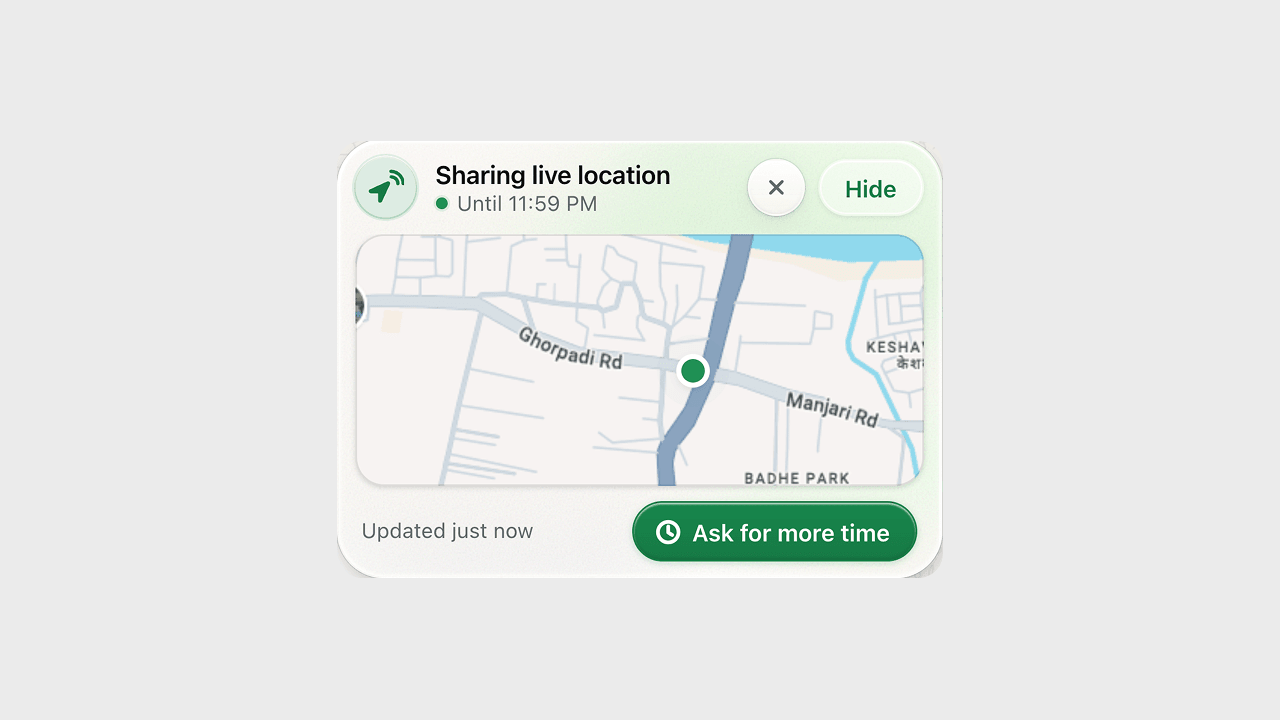
Live Pin attaches a small frosted-glass pill beneath the contact name whenever the original card is out of view. One tap expands it into a map with the live marker. When the original card is visible, the pill steps aside so the same information is never shown twice.
A Small Surface With Complete States
The interaction is intentionally modest: open the map, close it by tapping away or pressing Escape, or ask the sharer for more time. The request turns into a quiet status sequence rather than staying an active button, which makes its progress clear and prevents an accidental second request.
Dismissing the pin is reversible. A short Undo window catches the immediate mistake, while a “Turn on Live Pin” action remains on the original location card for later recovery. Every state has a clear way forward or back.
Designing For Group Chats
Group chats make the idea harder: several people can share at once. Live Pin starts off by default in a group and allows one person to be pinned at a time. The pill names the person being followed, and choosing someone else requires intentionally turning the current pin off first.
That constraint keeps the surface calm. Multiple floating maps would turn a chat into a dashboard; one named pin keeps the purpose legible without taking over the conversation.
The Other Side Of The Request
Asking for more time is only half the conversation. On the sharer's side, the request arrives as an ordinary incoming chat bubble with Approve and Decline directly beneath it. Neither answer is treated as a destructive action: both options carry equal visual weight, so the choice feels clear rather than socially loaded.
The request asks for the same duration as the original share. A 15-minute share asks for 15 more minutes, while an hour-long share asks for another hour. That makes the boundary predictable: the viewer cannot turn a short share into a much longer one, and the sharer only needs to answer yes or no. Once answered, the controls become a quiet status line in the conversation. In a group, that line also names the person whose request was answered.
Designing A Calm Presence
A live location is different from an ordinary message. It is both time-sensitive and spatial, but it still needs to live inside a conversation without turning that conversation into a tracking dashboard. The design challenge was to make it available at the right moment without making it constantly demand attention.
That is why the default surface is a small, contextual pill rather than a permanently open map. It carries only the essential signal: that someone is sharing, who it is in a group, and when the share ends, while the map is one intentional tap away. The location stays present when it is useful, then yields to the chat when it is not.